
Configurable or custom software: which solution should I choose?
Most large companies invest in software solutions that can meet their exact functionality requirements. Such software should be able to digitize, automate or simplify specific agendas within the organization in a way that adds value to employees and customers and ultimately delivers new business value and cost savings. This is also the reason why off-the-shelf software solutions (so called out-of-the-box) is sufficient for large companies, so it is worth considering customized or configurable software.
Although it may not be obvious at first glance, there is a significant difference between configurable software and a bespoke solution. Both approaches have their advantages and disadvantages. Configurable software is essentially a ready-made software solution, but one that allows you to customize selected aspects, often without the need for developer involvement (called low-code). Configurable software is flexible, scalable, and can be continuously modified to meet the changing needs of the organization specific to the industry and the organization. In contrast, bespoke software is developed specifically for a particular customer by a development team, taking into account all customer specifics and needs. However, it is "static" in the sense that any changes to functionality require the intervention of programmers and updating of the system code.

Configurable software versus customised software
Bespoke software from a reliable supplier can cover virtually any agenda. Of course, really good software also comes with relatively high costs, longer and more difficult implementation, and large IT teams and external consultants are needed to develop and deploy it. And that's whenever your business moves to a new level and your software requirements change as a result. However, as digital transformation evolves, so does this approach. The rise of cloud and SaaS solutions, the constant acceleration of technological change and the need to react to it more flexibly than ever before, has led to the need to configure software solutions quickly and easily without the need to involve large IT teams, even for small changes.
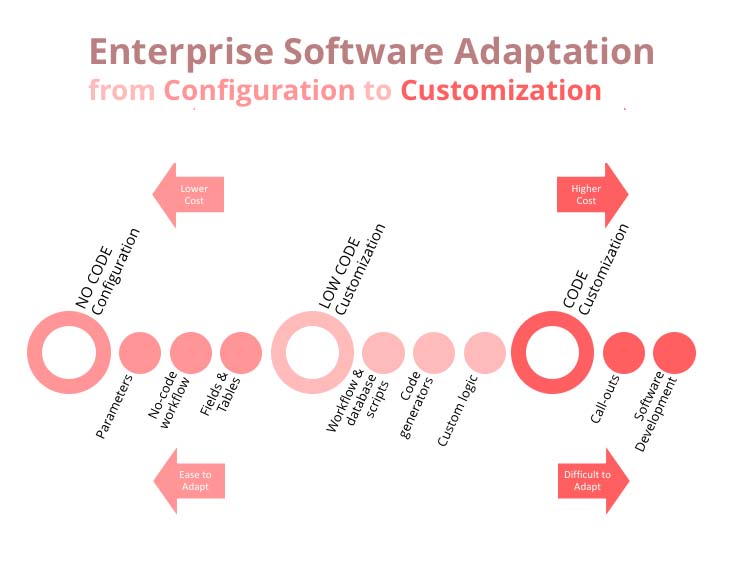
Customizing in this context means writing new code (programs, scripts and other artifacts) into custom software. Configuration is understood as the use of tools integrated within the software that allow specific requirements to be met without code intervention.
Tailored software and customisation
The choice of software is mainly influenced by the purpose of its use. Off-the-shelf software tools cannot always meet all functionality requirements, especially in large companies with complex processes and procedures and complex infrastructure. This is where customisation and bespoke software development comes in. In this case, developers have to modify an existing program or write completely new code so that the software can also perform tasks that are not currently part of its functionality.
Examples where customization of the software solution is used:
- Backend banking systems
- Solutions requiring integration to internal company systems
- Solutions for production management
- Systems for comprehensive reporting
- Decision support systems
- Business process automation systems
- Automatic invoicing
Benefits of customised software:
⦿ Customized software exactly meets the functionality requirements replicating your business. This speeds up your work, processes and digitalization, as it eliminates conflicts caused by insufficient features of the software solution.
⦿ The software adapts to your processes and employees, not the other way around. This eliminates the need to retrain employees or change workflows based on software.
⦿ Custom software is dealt with frequently without additional licensing fees. You may pay more for the initial solution, but in the long run you save money on monthly or annual license fees. In the same way, business process continuity saves time and costs in other dimensions of the business.
⦿ Customized software belongs exclusively to your company and is under her absolute control. If you want to make any changes, you don't have to wait weeks for feature requests. You work directly with your development team.
⦿ Software is often evolves as part of the entire enterprise IT infrastructure, is therefore a direct part of it. This ensures Compatibility within the overall information flow, as well as integration with other systems.
⦿ Custom software development also takes into account your the company's security and technical infrastructure requirements. These aspects are fully in your hands and tailored to your business to make the resulting tool as reliable as possible.
Disadvantages of bespoke software:
⦿ Implementation is often difficult and costly. You are starting from scratch, creating something unique. This, of course, requires a lot more time and initial costs. While ready-made software can be deployed in a few days, custom software takes months to deploy. The initial financial cost makes it especially suitable for large enterprises.
⦿ Yours the system is static, it does not evolve within the industry. Digitalisation and the speed of technological change is accelerating every year, which also has an impact on business and business processes. Thus, bespoke software designed for certain processes and workflows may be obsolete in a few years and may require massive developer intervention to update.
⦿ No one else uses the same software as you. On the one hand, it gives you a competitive advantage to make the software as efficient as possible for your business. On the other hand, it means that there is no user community to share experiences with. A direct relationship with the supplier is essential. Training of new employees is also necessary.
⦿ Find a reliable software developer is for business owners a real by calling. He should understand your business processes, have a high level of technical knowledge and list of successfully completed projects and customer reviews.
⦿ In your team you need technically proficient specialists to monitor the software workflow and resolve any issues that arise. The alternative is to work closely with the development team whenever something goes wrong, which is also costly.
Configurable software and configuration
Configurable software has certain default features that you can configure based on your preferences. Configuration takes place during the software deployment process. You work with consultants using tools and applications that are already part of the software. With their help, you can modify, for example, fields, values, dials, roles and system functions to best suit your business processes and business. Software configuration does not require programming, ideally not even extensive technical knowledge, and does not affect any fundamental aspect of the software's operation. Configurability is part of it and one of its most important features. Such software has, in simplified terms, a set of pre-prepared components or modules that can be combined in various ways and adapted to specific business needs. Developers do not create software from scratch, but build it on a ready-made core that is configurable to your business processes.
Examples of configurable solutions:
Benefits of configurable software:
⦿ Implementation time is significantly reduced. Because you are buying a system whose basic structure is the same for all users, deployment takes from a few days to a few weeks.
⦿ The configurable system foundation is used by many organizations. The software provider thus has continuous feedback and is able to identify and incorporate updatesthat will benefit the majority of potential users.
⦿ Updates to the system are generally free of charge. While a customised solution requires you to hire a software developer to make any changes or updates, configurable system providers continuously install updates for you to run more efficiently. These updates are usually included in the subscription price.
⦿ Most providers of configurable solutions include online communities with whom you can share best practices and read about new and innovative ways they are using or configuring their system.
⦿ Configurable solutions bring much lower initial costs. There are also standard free resources - user manuals, training, tutorials, as they are relevant for all customers. Thus, there is not as much need for training of new employees.
⦿ Configurable software is often developed by narrowly focused companies. This means that developers only work with a certain segment market - banks, manufacturing, marketing... They have knowledge of the processes in the industry.
Disadvantages of configurable software:
⦿ You don't get the update when you need it you, but when the service provider schedules it. This does not always correspond with the actual requirements of your business.
⦿ The system can be limited by the number of configurationsthat can be performed within the software. This makes it more consistent on the one hand, but on the other hand it makes it more rigid by setting constraints.
⦿ Your employees and users of configurable software must understand terminology and abstract vocabulary defined by the service provider.
⦿ When working with a company focused on a wide range of solutions and business domains, you run the risk of getting software with poorly implemented processes.
⦿ It is questionable how long a configurable system can meet the requirements as your business grows. The more complex your business processes become, the more the limitations of such a solution start to become apparent.
⦿ In configurable solutions, the number of features you can implement is limited by its "cornerstone". It's a fast way to build software, but when you need a unique feature that is not available, you need some custom code. Integrating this custom code can sometimes cost much more than a fully customized solution built from scratch.
⦿ Configurable solutions have integrated security protocols, but still cannot provide the same level of security as custom software. You do not have complete control over the security of the data or access to the source code.
How to decide which approach to take?
Bespoke software is not for everyone. This type of software is suitable for banks, large lenders with established business practices and large manufacturing companies. Configurable software is the "happy medium," so to speak. The initial cost is much lower than customized software, but it still provides much more functionality than an out-of-the-box solution. This is why many developers see the future of software in configurable and low-code or no-code solutions. Currently, the most likely situation is that a company will use both or a combination of these approaches within its IT infrastructure. Services such as Office 365, Microsoft Dynamics or Solvedio make it possible to cover part of the processes by configuration. What cannot be covered by configuration can be implemented as an extension.
When making a decision, it is important to consider in particular:
- Purpose of the software: Think about what business processes the software solution will cover, what tasks it is intended to digitise and what its primary use will be. This very first point can offer you a clear answer to the question of whether to choose a configurable solution or a bespoke solution.
- Budget: The initial cost of custom software is orders of magnitude higher than the initial cost of a configurable solution. On the other hand, for configurable software you usually pay a time subscription or a subscription fee for a certain number of users or versions. It is therefore very important to also consider the savings that bespoke software will bring to your business in the long run. On the other hand, there are upgrades, which are traditionally free of charge with configurable systems, whereas custom software upgrades require the involvement of a development team and time.
- Implementation time: You can implement a configurable solution into your IT infrastructure in a matter of days or weeks. Implementing a customized solution usually takes months. This can also be an important factor that weighs in your decision.
- Your business segment and business goals: Some segments are evolving faster than others in technological terms. Therefore, a higher degree of flexibility is essential for them, which is what configurable software offers. On the other hand, there are segments with robust workflows whose requirements can be much better covered by customised software.
From the above, it is clear that different clients need different levels of customisation of their software, based on their specific business needs. Configurable software can be about finding compromises in terms of functionality in some ways, on the other hand it has an undeniable advantage in terms of acquisition cost and speed of implementation. Choosing a reliable partner in this respect will help you answer very clearly the basic questions regarding the selection of a suitable solution. Especially if the partner is engaged customised software Also configurable solutions.