
Cloud FinOps - cost optimization in cloud transformation

What is Cloud FinOps?
Cloud FinOps, also known as Cloud Financial Operations or Cloud Financial Management, refers to the practice of managing and optimizing costs to ensure efficient use of cloud resources, maximizing their value while minimizing unnecessary spending.
Cloud FinOps represents a paradigm shift in the way organizations approach cost management in the cloud. It brings together financial management, business intelligence and cloud technologies and focuses on collaboration between finance, operations and engineering teams, with an emphasis on aligning cloud spend with business objectives. By leveraging Cloud FinOps practices, companies can gain a comprehensive view of cloud spend, increase its value to the enterprise, allocate resources efficiently, and make data-driven decisions.
Piliére Cloud FinOps
- Governance and Accountability: The foundation of Cloud FinOps is establishing clear governance structures and assigning accountability for cloud usage and spending. By defining policies, putting controls in place, and creating cost awareness among stakeholders, organizations can achieve cost optimization at all levels.
- Continuous optimization: Cloud FinOps is not a one-time activity, but an ongoing process. It involves monitoring and analysing cloud costs, identifying optimisation opportunities and implementing changes to ensure ongoing efficiency. By leveraging analytics and automation, businesses can achieve real-time visibility and cost savings.
- Cooperation and communication: Successful Cloud FinOps requires collaboration between finance, operations and development teams. Overcoming cross-departmental barriers and fostering communication between different functional groups allows organizations to connect cloud spend to business goals.
Benefits of Cloud FinOps
Implementing a Cloud FinOps framework brings a business undergoing cloud transformation, several significant advantages:
Comprehensive overview and cost control
Provides organisations with real-time visibility into their cloud spend. It enables detailed tracking of cloud resource usage, identifies areas of overspending and facilitates proactive measures to optimise costs. By gaining control of these costs, businesses can more effectively set their budgets and make informed decisions to streamline spending. Simply put, with Cloud FinOps, you have constant visibility into whether you're getting real value for your money spent on the cloud.
Improving operational efficiency
Using Cloud FinOps, you can easily optimize your cloud resources based on the real needs of your business. This way, you get rid of unnecessary spending on unnecessary resources that are underutilized. Simply right-size your cloud instances, optimize your storage spaces, and leverage automation to save costs. These measures will help you achieve greater operational efficiency and significantly reduce costs over time.
Responsible cost allocation
FinOps allows you to detail cost allocation and assign cloud spend to specific teams, projects or business units. This not only increases financial transparency, but also promotes a culture of accountability, efficient use of resources and cost awareness across the organization.
Continuous optimization and agility
This is an ongoing process that involves regular monitoring, analysis and optimization of cloud costs. By leveraging spend and data analytics, you can identify trends, patterns and opportunities for improvement. This iterative approach to cost optimization ensures that you can quickly adapt to changing demands and take advantage of emerging cost-saving initiatives.
Best Practices for Cloud FinOps
To maximize the benefits of Cloud FinOps and unlock cost optimization in cloud transformation, you should follow these best practices:
1. Ensure functional collaboration
Cloud FinOps requires collaboration between finance, operations and engineering teams. Creating teams and fostering open communication is critical to aligning cloud spend with business goals. By engaging all stakeholders from the outset, organizations can create a shared understanding of cost optimization goals and foster a culture of accountability.
2. Implement cost management tools in the cloud
Retrieved from cloud-based cost management tools and platforms and get detailed information on resource use and costs. These tools provide comprehensive dashboards, cost allocation functions and automated optimization recommendations. By leveraging these capabilities, enterprises can make informed decisions, implement cost-saving measures, and continuously monitor and optimize their cloud costs.
3. Take advantage of the cloud provider's cost management features
Major cloud providers offer native cost management features (Amazon CloudWatch, Microsoft Cost Management...) that organisations can use to gain a holistic view of their costs and implement optimisation strategies without further investment in third-party tools.
4. Create a cost management policy
Developing and enforcing cost management policies is essential to maintaining cost control and accountability within the organization. Establish clear guidelines for resource provision, monitoring usage and budget allocation. Periodically review and modify these policies to adapt to changing business needs and optimize cost management practices.
5. Foster a culture of cost awareness
Educate employees on the cost impact of their cloud usage and encourage responsible use of cloud resources. By empowering individuals to make cost-conscious decisions and providing ongoing training on Cloud FinOps practices, businesses can ensure that cost optimization becomes ingrained in their organizational culture.
FinOps Foundation and the FinOps Framework
The FinOps philosophy is a relatively new initiative and was created in response to the rapid emergence of cloud transformation in business in recent years. With this has come the need for cloud-based financial management through best practices, education and standards. In 2019, the project was created FinOps Foundation Linux Foundation (along with organizations like the Cloud Native Computing Foundation ), which is dedicated to developing people practicing the discipline of cloud financial management. The FinOps Foundation is a community of more than 8,700 people representing more than 3,500 companies. It provides a variety of training and certification programs and includes dozens of major service and platform providers. In addition, it has created a FinOps frameworkwhich provides an operating model for how to establish and excel in FinOps practice.
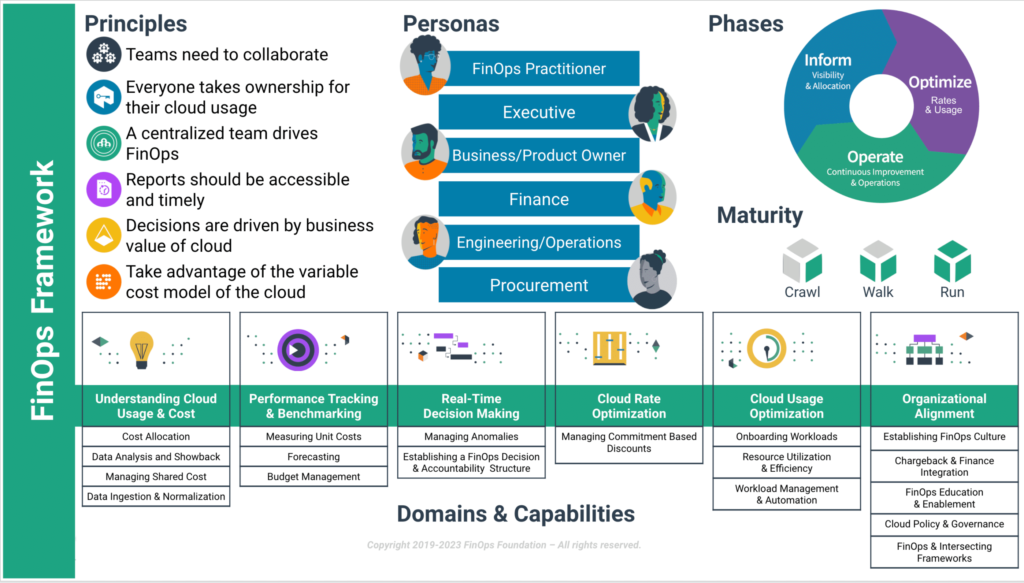
FinOps Framework from the FinOps Foundation. The framework is evolving just like FinOps. (SOURCE: finops.org)
Are you interested in the principles of CLoud FinOps?
Would you like to learn more about how you can optimize cloud costs to ensure efficient use of cloud resources, maximizing their value while minimizing unnecessary spending?
Contact Us Conclusion
Cloud FinOps plays a key role in cost optimization during cloud transformation. By implementing best practices, a FinOps framework, leveraging cloud cost management features or tools, and creating an environment that fosters collaboration and a culture of accountability, you can not only gain better visibility and control of your cloud costs, but also get the most value from your cloud investments.
As companies increasingly use the power of the cloud and cloud solutions, adopting principles and practices to optimise cloud costs will, in our view, be essential in the period ahead to remain competitive, achieve cost efficiency and maximise return on investment. Choose a partner that has extensive and proven experience with cost-effective cloud solutions and implement Cloud FinOps principles in your organisation.
Did you like the article?
Sign up for the newsletter
Share it on social networks
You might be interested in
-
Aspecta has become a cloud partner of Oracle09 Jan 2023 From the life of Aspecty
-
Cloudification of the controlling solution for Slovak Telekom, T-mobile Czech Republic (Deutsche Telekom)05 dec 2022 Case Studies
-
Advantages of cloud solutions for your company28 jún 2022 Digitisation of business processes
-
Are you fully harnessing the potential of the cloud? Cloud migration vs. cloud transformation24 nov 2021 Cloud