
Kubernetes and containers - why will 85% of companies deploy them by 2025?
According to analyst firm Gartner, by 2025, up to 85 % enterprises in developed economies will deploy containers. Currently (2022), approximately 30 % organizations are using containerization platforms. This significant growth is expected to be reflected in the global container management market, which breaks the $14 billion mark and the annual growth rate is expected to be 25.1 %. This is all due to the unrelenting demand for flexibility, agility and digital business transformation. Containerization will become the trigger for a new round of the global transformation marathon.
The digital transformation is taking place along three main lines:
- Digitisation of in-house processes in order to transform business and improve communication with customers and partners.
- Cloud adoption and adoption to increase agility and flexibility. Cloud-native applications can be deployed and patched faster and can easily move across environments, making cloud-native the new norm.
- A new approach to application development and the transition to continuous integration and deployment (CI/CD), allowing for frequent and iterative changes.
Containerisation and containers become the element that connects these lines.

What are containers?
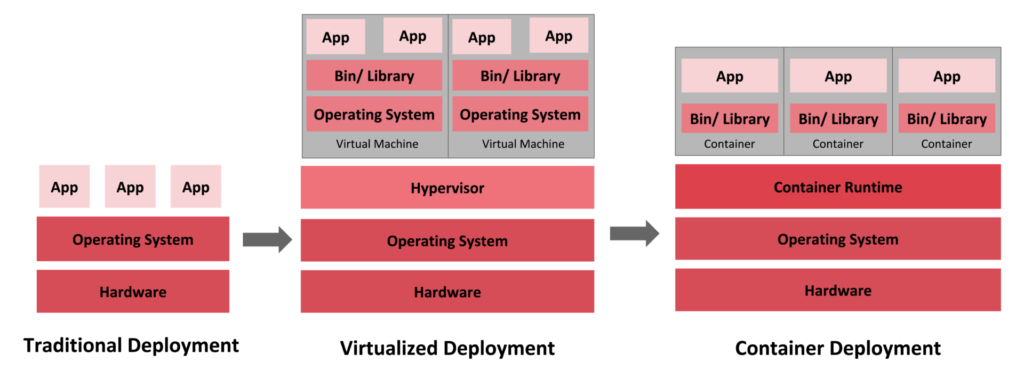
Kontajnerizácia is wrapping the software code with all the necessary components (e.g. libraries, frameworks, etc.) so that they are isolated in their own "container". Software or applications packaged in this way can be moved and run consistently in any environment and on any infrastructure, regardless of the operating system of that environment or infrastructure. A single container can be used to run anything from a small microservice or software process to a larger application. The container acts as a kind of bubble or computing environment surrounding the application and keeping it independent of the environment. It is essentially a fully functional and portable computing environment.
Containers make it easy to deploy cloud applications because they contain all the information needed to run them in manageable packages. They enable the continuous development of applications that are extremely self-contained, highly scalable, portable and at the same time granular in terms of the service components that make them up.
The deployment and organization of containers to support applications is called container orchestration, which is done through a dedicated tool. Popular open source container orchestration tools include Kubernetes or Docker Swarm.
The benefits of containerization and Kubernetes for business
Companies with rapid demand growth, frequent new product launches or massive data analytics requirements will appreciate that containers can be quickly scaled, cloned and imported into new environments. Other benefits of using containers for your business include:
- Improved business agility: Containers enable faster deployment of applications and services, as well as easier and more consistent management of those applications and services, creating a more agile infrastructure. They allow developers to quickly make small changes without disrupting application workflows. When a problem or change needs to be addressed in one part, it doesn't require a complete redesign of the entire system. All of this has a significant impact on the operation of the entire business and business processes.
- Increased cost savingsA: Container apps can run on any platform, meaning businesses no longer need to rely on specific hardware or software platforms to run these apps. In the long run, this will lead to significant cost savings for businesses.
- Higher revenues and customer satisfaction - Faster delivery of products, features and upgrades means significant time savings and increased agility. On the one hand, you're able to create digital products more efficiently than ever before; for physical products, you can translate the time and resource savings into higher value-added areas of the business that directly impact customer satisfaction and profit.
- Greater scalabilityA: With containers, businesses can quickly and easily add or remove resources as needed to meet changing demands. This scalability is a critical advantage in an increasingly competitive market.
- Improved securityA: The containers are isolated from each other, which means that if one container is infected, the others are not affected. The separate and immutable aspect of the containers provides increased security when working with developers outside the organization. This makes containers a safer choice for enterprises of all sizes.
Perhaps the most important advantage of containerization is that it allows applications to be "written once and run anywhere". This accelerates development, prevents cloud vendor lock-in, and offers other notable benefits such as fault isolation, simple management, simplified security, and more. Kubernetes, which is the de facto standard for container orchestration, and which we at Aspect also work with, offers a high degree of scalability and flexibility for containerized applications due to its architecture, ubiquity, and broad industry support.
However, the benefits of containers must also be understood in the context of technological challenges: the complexity of platforms, the need for robust automation, security and, not least, organisational, cultural and skills challenges. The deployment of containers in a large company requires a mature process DevSecOps, extensive processing of process components, consistent operations and upgrading of existing tools and processes to ensure automation and control.
"Containers and Kubernetes are driving the transformation of how we build and run applications, making enterprise IT more efficient."
By Daniel Teixera, Systems Engineer at Pure Storage
The 4 most common uses of containers
-
Standardisation
Containers are a great way to provide a standardized development, test and production environment. The challenge in setting up different environments is installing and maintaining all the necessary infrastructure services such as databases and message brokers. Maintaining an environment for all developers is error-prone and time-consuming. Containers make it easy to ensure consistency regardless of the environment.
-
Automation
The containers are easy to use with APIs and therefore also suitable for automation and continuous integration/continuous deployment (CI/CD) pipelines.
-
Microservices
Containers are ideal for microservices architectures where applications are divided into small, self-contained components that can be individually deployed and scaled. Containers are a very good choice for deploying and scaling each of these microservices.
-
Multi-cloud
Containers provide much more flexibility and portability than virtual machines in multi-cloud environments. When software components are deployed in containers, these containers can be easily "lifted and switched" from on-premises native servers to on-premises virtualized environments to public cloud environments.
The benefits of containerization and Kubernetes for business
Despite the growing popularity of containerization among enterprises, the ratio of containerized applications is still not high: Gartner estimates that less than 5 % enterprise applications are containerized today. In contrast, the adoption rate is extraordinary by comparison. According to 451 Research, there are already 95 % currently develops applications directly in containers.
However, in terms of skills, it is still a challenge to find a reliable supplier and containerisation provider that also has real experience with these solutions. In doing so, the return on investment by building a thorough container-based infrastructure is confirmation that containers and Kubernetes are not just a trendy thing. Sooner or later, most companies will have to go through this transformation if they want to remain competitive in the market. If you too are considering a similar direction for your business, don't hesitate to get in touch with us. V Aspecte We have extensive experience with containerisation and we can match the solution perfectly to your requirements and the requirements of your business. Join the more than 85 % companies worldwide that will deploy containers by 2025.