

About the product
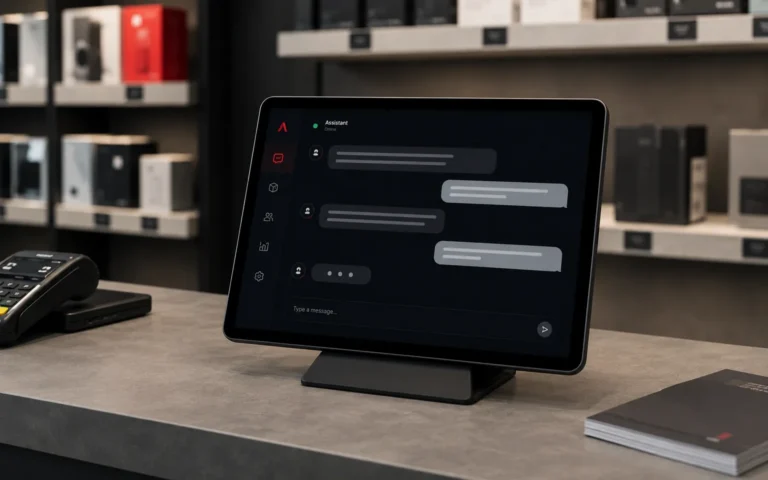
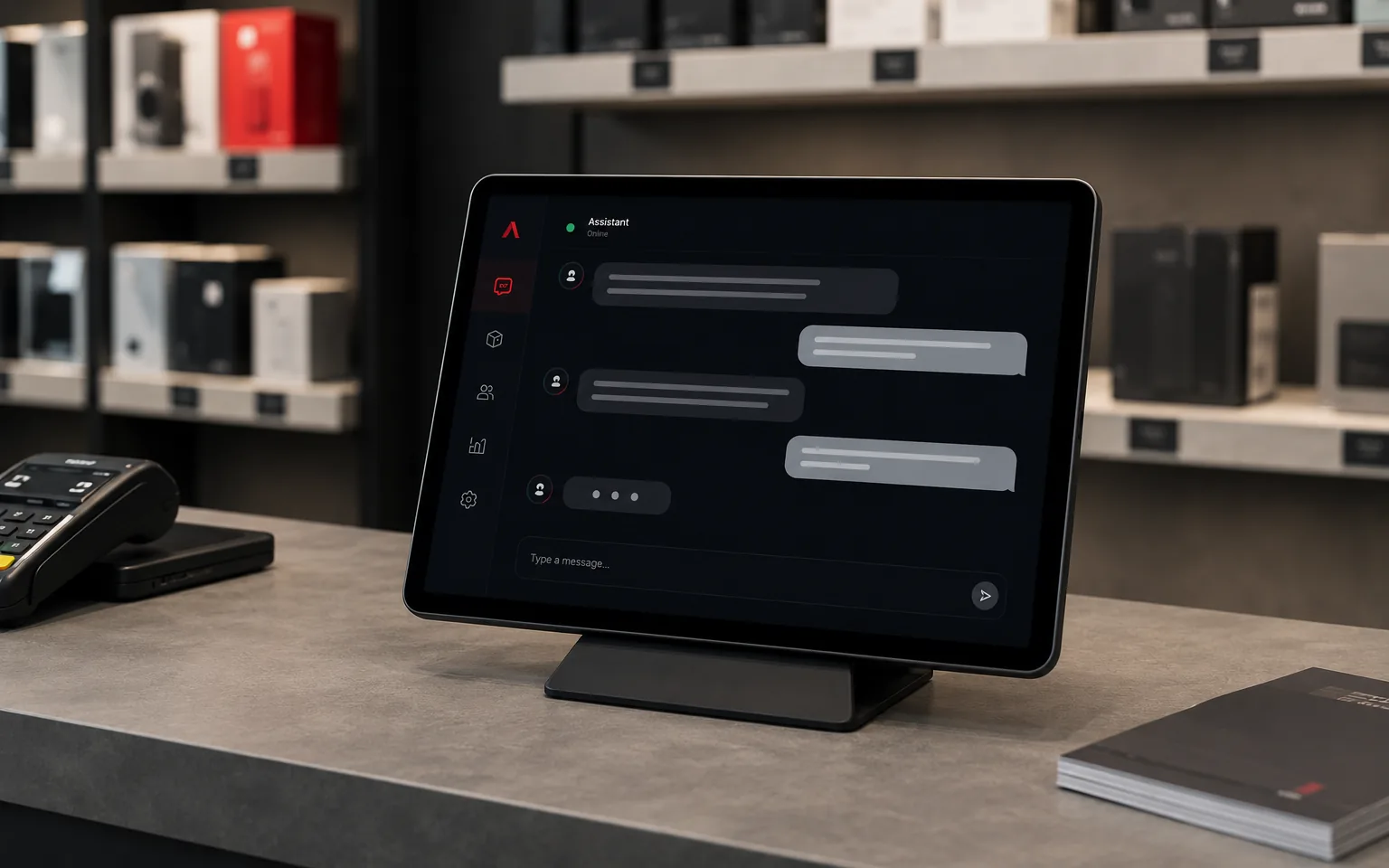
AI Smart Assistant is Aspecta’s own product, which the company develops and operates for online stores in Slovakia and the Czech Republic. It helps shoppers choose products and answers their questions in Slovak and Czech.
Its answers are based on the specific store’s product catalog, which is updated daily, and on other documents such as terms and conditions, the returns and complaints policy, or FAQs.
The product is rolled out to customers gradually, from a prototype (PoC) through an MVP to production. Aspecta has already built dozens of prototypes for various online stores. This case study focuses on the development of the product itself, its architecture, and how Aspecta verifies that the recommended products are correct.
Background
A prototype that had to handle a growing number of deployments
AI Smart Assistant was originally built as a quick prototype in a single shared AWS account. Security, monitoring, and deployment matched this stage of development. As more customer prototypes were added, however, several problems began to hold back the original solution.
The first issue was the capacity limits of Amazon Bedrock, which are tied to the AWS account. Under higher load, the model rejected some requests, and responses arrived with significant delays or were not displayed progressively.
Deployment also became more complicated. Adding a new prototype triggered a plan to redeploy all existing environments. The more environments there were, the longer it took to add another customer.
Answer accuracy was a separate problem. The assistant sometimes failed to find the right product even though it was available in the catalog. The built-in Amazon Bedrock search did not provide enough visibility into how products were selected, which made it harder to find causes and tune the results.
Differences between online stores made things even harder. The XML feeds had different structures and data quality, which caused problems with prices, categories, and product URLs. Some descriptions contained clear information, while others consisted mostly of product codes.
Aspecta’s goal was to prepare an architecture that would make it possible to separate environments securely, add new online stores without affecting existing deployments, and systematically measure and improve search accuracy. The solution also had to work for different product catalogs.
Solution
Separate environments and automated deployment
Aspecta split development, testing, and production into separate AWS accounts. This separated the individual environments, their costs, and the service limits of Amazon Bedrock and AWS Lambda.
To increase available capacity, Aspecta also calculated the expected load and asked AWS to raise the quota for Claude Sonnet 4. In August 2025, AWS approved an increase from 80 to 800 requests per minute.
Aspecta built infrastructure management on a single Terraform repository that serves as a shared source of configuration for all environments. Deployment through GitHub Actions covers planning and applying changes, approved environment teardown, and releasing new versions.
Changes go through static analysis and approval via pull request. Access to AWS uses temporary credentials via OIDC.
Changing the deployment itself was also important. If the application has not changed, adding an online store deploys only its new environment.
Processing catalogs and answers
Aspecta moved product catalog loading to AWS Batch, because processing large XML feeds was running into the time and memory limits of AWS Lambda.
The catalog is checked every day. The system compares the feed checksum, processes the product data, and stores it in Amazon S3 and Amazon DynamoDB. It then synchronizes the data to the knowledge base.
Instead of a universal import mechanism, Aspecta chose its own, simpler data schema. This helped reduce errors caused by different feed formats and made processing easier to debug.
The chat itself works asynchronously. A customer’s request is stored in Amazon DynamoDB, from where it is passed on for processing through Amazon DynamoDB Streams. The answer generated with Amazon Bedrock is then displayed to the user progressively.
Custom search with measurable accuracy
With the original search, Aspecta lacked sufficient visibility into why the system selected particular products. It therefore replaced it with its own hybrid search, which combines keywords and semantic similarity.
The results of both approaches are merged using Reciprocal Rank Fusion (RRF), with brand matches also taken into account. Product data and other documents are split into two knowledge bases with different text chunking methods. Vector data is stored in Amazon Aurora PostgreSQL with the pgvector extension.
At the same time, Aspecta introduced repeatable accuracy evaluation using the DeepEval framework and custom metrics. These track whether the retrieved context and the final answer contain the correct products from the test set. The tests run on AWS Batch, and the results are stored in Amazon S3.
Every change to the search or the model can therefore be evaluated with the same procedure and compared with the previous configuration.
In April 2026, Aspecta compared four Claude models on a common set of questions. Claude Sonnet 4.6 achieved the best results and has been used in production ever since.
The solution also includes customer and internal dashboards. In them, both the online stores and Aspecta can track business and application metrics, including latency, reliability, token consumption, and Amazon Bedrock errors.
Technical details
| Layer | Technology | Purpose |
|---|---|---|
| AI | Amazon Bedrock (Inline Agent, Knowledge Bases), Claude Sonnet 4.6 | Understanding the question, selecting products, and generating the answer |
| Search and data | Amazon Aurora PostgreSQL (pgvector), Amazon DynamoDB, Amazon S3, Amazon SQS | Vector and hybrid search, processing chat tasks, storing products and evaluation results |
| Processing | AWS Lambda, AWS Batch on AWS Fargate, Amazon EventBridge | Chat processing, daily catalog loading, and accuracy evaluation |
| Interface | Amazon API Gateway, Amazon CloudFront, Amazon Cognito | Chat access, customer and internal dashboards with sign-in |
| Operations | AWS Organizations, AWS Control Tower, Amazon CloudWatch, Terraform, GitHub Actions | Separate accounts, infrastructure management, automated deployment, and operations monitoring |
Implementation
The first prototype of AI Smart Assistant was created in January 2025. After experiencing capacity limits over the summer, Aspecta began in the fall to rework the architecture, design separate accounts, and move catalog processing to AWS Batch.
From December 2025 to February 2026, development focused on hybrid search and repeatable accuracy testing. In March and April, operational dashboards, a new production account, and faster deployment followed.
By August 2026, Aspecta had moved the production environments of five customers to a separate AWS account and automated the creation of additional customer environments.
Results
New customers without redeploying existing environments
Aspecta now manages PoC, MVP, and production environments from a single source of configuration. Their creation, updates, and removal are handled through automated processes with approval steps.
A new online store can be added without redeploying other customers’ environments, as long as the application code does not change. Production also runs in its own AWS account, separate from development and prototypes.
Aspecta now deploys the infrastructure for a new online store on AWS in 4 to 8 hours. The store then adds a short code snippet for the chat window to its website. The catalog is loaded automatically overnight, which takes a few hours depending on the number of products and the data structure. Technically, the assistant can therefore be up and running the next day.
Answer accuracy can be tested repeatedly
A series of tests in January 2026 showed how big a difference both the search configuration and the product catalog itself can make.
Using the product catalog of an online store selling spare parts, the team tested 10 questions, repeating each one 100 times. This produced 1,000 answers for each configuration. An answer was considered valid if it contained at least one correct product from the test set.
| Test | Share of valid answers |
|---|---|
| Baseline configuration, spare parts | 61.2% |
| Best configuration, spare parts | 66.8% |
| Same best configuration, outdoor products | 36.9% |
Even within a single catalog, the results were uneven. With the best configuration, the success rate of individual questions ranged from 11% to 94%.
The tests confirmed that results depend heavily on the specific questions and product data.
What production shows
In production, Aspecta tracks how many questions the assistant was unable to answer or provide help with. This is how it looked in two online stores in 2026:
| Online store | Period | Messages | Outside business hours (5 p.m. to 8 a.m.) | No answer found |
|---|---|---|---|---|
| Online store A | May to September | 7,069 | 41.0% | 15.9% |
| Online store B | April to September | 2,399 | 36.9% | 18.6% |
The questions without an answer also include questions about products or services the online store does not offer at all. Answer accuracy also depends on the data the online store provides: if its catalog has incorrect or mixed-up categories, the assistant cannot fix that.
Conclusion
The development of AI Smart Assistant also produced insights that matter when designing similar RAG solutions.
The evaluation showed that a small test set from a single online store is not enough. Not every technically more advanced approach delivered better results. Semantic text chunking with Claude Haiku 4.5 increased costs and lengthened data synchronization without improving the main metrics.
For further development, the ability to monitor and specifically adjust the search remains important, because answer quality also depends on which products reach the model’s context in the first place.
Aspecta continues to develop version 3.0. It plans to move the chat to the Amazon ECS container service on AWS Fargate, stream answers directly to the browser, and use its own knowledge base on Amazon Aurora PostgreSQL with full-text search and reranking.