

Key points:
- Implementing an AI chatbot improves access to HR data in the telecommunications sector.
- Reducing Power BI barriers simplifies access for nontechnical employees.
- Integrating Azure and OpenAI provides a secure, scalable solution that supports efficiency.
- Faster data retrieval reduces the time required to obtain information.
- A better user experience improves employee satisfaction and productivity.
Effective HR management depends on fast access to accurate data. Telecommunications companies need current HR information for informed decision-making, but traditional business intelligence tools such as Power BI can create barriers for nontechnical users and make routine access unnecessarily difficult.
AI solutions are increasingly being used in HR to simplify access to data and improve productivity. Chatbots and natural language processing allow users to interact with complex datasets more intuitively without navigating reporting structures directly.
The client
Our client is one of the leading telecommunications operators in Slovakia. The company provides a broad range of services including mobile and fixed-line connectivity, internet services, and digital television. With thousands of employees and millions of customers, it is a major participant in the sector and continues to develop its internal processes and customer services.
Challenges
The main challenge was the complexity and limited accessibility of HR data for nontechnical employees. Although Power BI provides extensive analytical capabilities, many users found the interface difficult to navigate, especially during meetings when managers and HR professionals needed information quickly.
This created several practical problems:
- Slower decision-making: Managers could not retrieve the required information quickly, delaying decisions.
- User frustration: Employees found it difficult to make full use of the available data.
- Inefficient use of resources: Time spent navigating Power BI reduced productivity elsewhere.
- Risk of poor decisions: Limited access to accurate data increased the risk of decisions based on incomplete or outdated information.
Based on these issues, the telecommunications operator defined the following project objectives:
- Simplify access to HR controlling data for nontechnical employees, especially B-level managers.
- Reduce the time required to retrieve relevant information during meetings and working sessions.
- Improve decision-making efficiency by providing immediate access to current HR data.
- Implement a solution that is fully integrated with the existing Azure infrastructure and meets the client’s security standards.
- Create a flexible system that can be extended easily in the future and adapted to changing business requirements.
- Improve overall employee satisfaction when working with HR data and support a data-oriented culture within the organization.
The solution
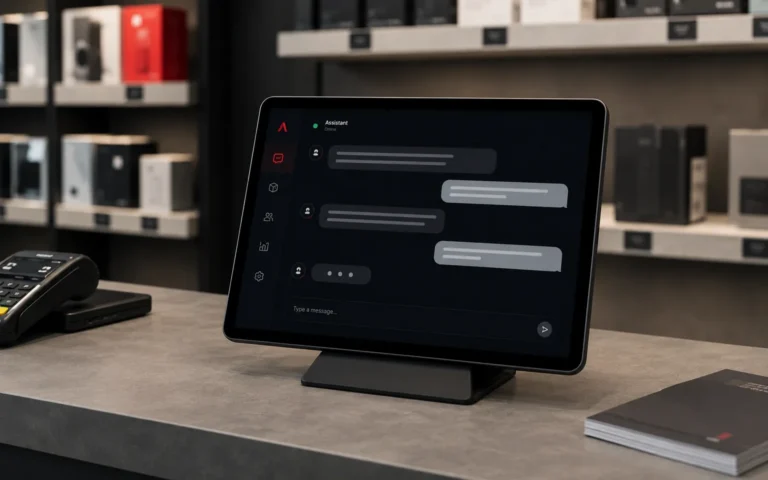
Based on the client’s requirements, we designed and implemented an AI chatbot fully integrated with the telecommunications operator’s existing Azure infrastructure. The solution changes how users interact with HR data by combining AI capabilities with the client’s existing cloud environment.
The main components include:
- Custom frontend and backend: We developed a tailored user interface and backend that match the telecommunications operator’s requirements and workflows, supporting intuitive use and integration with existing processes.
- OpenAI Assistant API integration: The solution uses OpenAI Assistant API with Code Interpreter. The chatbot can process and interpret complex user questions dynamically and return responses in natural language.
- Dynamic data retrieval from Power BI: We created an integration between the chatbot and existing Power BI reports, allowing it to access current HR data and provide relevant information.
- Secure Azure environment: The solution runs within the client’s Azure infrastructure, keeping sensitive HR data within the existing environment. Authentication, encryption, and security controls protect the integrity and confidentiality of processed information.
- Scalable architecture: The modular architecture supports future extensions, new functionality, and integration with additional data sources as requirements evolve.
The implementation also involved several challenges:
- Complex data structures: HR data was distributed across different Power BI reports with complex relationships. A mapping layer allowed the chatbot to navigate and interpret these structures.
- Answer accuracy: The chatbot needed to provide fast and accurate responses. The team introduced multiple quality controls, regular model updates, and user feedback mechanisms.
- Integration with existing security protocols: The solution had to comply with the telecommunications operator’s internal security standards. We worked closely with the client’s IT security team to implement additional authentication and encryption controls.
- User adoption: Initial skepticism required structured onboarding. Interactive workshops and detailed user guides helped employees adopt the new system.
Results
The AI chatbot for HR controlling delivered measurable results for the telecommunications operator:
- Higher efficiency: The average time required to retrieve relevant HR information fell by 70%, accelerating decision-making during meetings.
- Higher user satisfaction: An employee survey showed 85% satisfaction with the new system, a substantial improvement over the previous solution.
- Broader use of data: The number of active users working with HR data increased by 200%, indicating significantly wider access to information across the organization.
- Accuracy and reliability: Chatbot response accuracy reached 98%, exceeding the original expectations and increasing user confidence in the system.
- Time savings: Managers reported saving an average of 5 hours per week previously spent manually searching for and interpreting HR data.
The results show that the AI chatbot met the project’s objectives and exceeded several of the original targets. The telecommunications operator gained a practical tool that improves access to HR data and supports informed decision-making across the organization.
Conclusion
The AI chatbot for HR controlling addressed the immediate problems associated with access to HR data and created a foundation for further development of analytics and AI within the organization.
Key benefits of the project include:
- Broader access to data, supporting informed decision-making across the organization.
- Higher efficiency and productivity, particularly among managers.
- A flexible and scalable architecture that can be extended to additional business areas.
- A stronger internal capability to use AI in HR processes within the telecommunications sector.
The project demonstrates how an appropriately implemented AI solution can change internal processes and make data easier to use. For the telecommunications operator, this means faster HR controlling today and a foundation for further data-driven development.
This case study is hypothetical and based on an ongoing project with a telecommunications operator where we are currently developing a demo version of the AI chatbot. The stated results illustrate the realistic potential of the solution.