

The challenge
The retailer faced pressure from a changing market where success no longer depended only on the breadth of its product range but also on the ability to respond quickly and accurately to customer needs. Online visitors expected the same level of service as in a physical store. Without an assistant to help with product selection and compatibility, decisions took longer and customers were less likely to complete purchases. The retailer needed to connect product data, employee knowledge, and its digital channel through a single intelligent interface.
-
Complex product range: an extensive catalog including equipment, tiles, and kitchen systems made online purchasing decisions more difficult.
-
Low online conversions: customers often abandoned their carts because personalized assistance was unavailable.
-
Risk to competitiveness: digital competitors with fast, personalized experiences were gaining market share.
-
Underused data: customer interactions were not sufficiently connected with marketing and product development.
The solution
Before deploying the AI Smart Assistant, the retailer considered a traditional recommendation system and enhanced full-text search. These approaches could not respond to the context of customer questions, explain product choices, or adapt to individual preferences. The retailer needed a solution that combined data accuracy with natural interaction and could use existing catalog and customer data without changes to the core infrastructure.
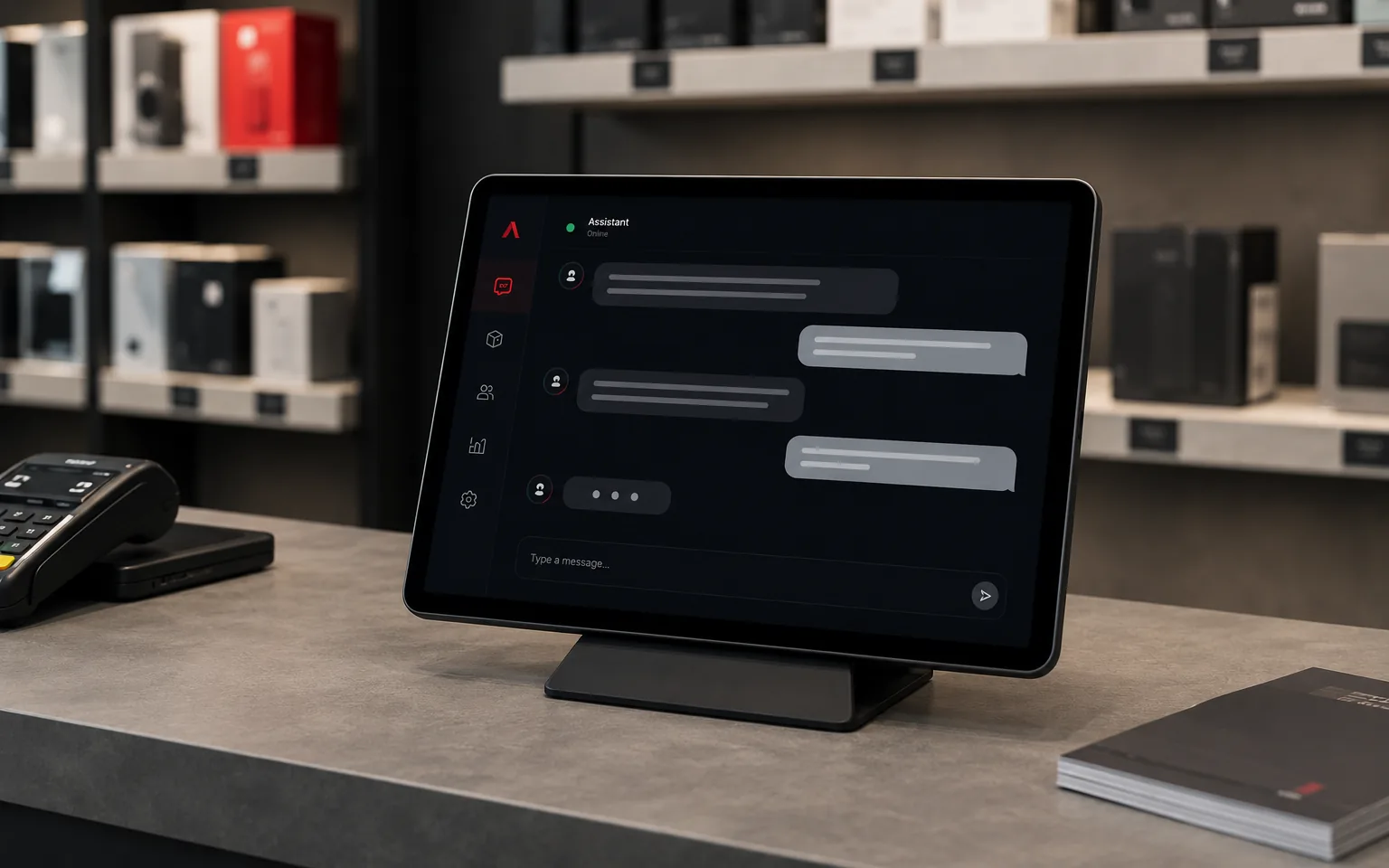
Aspecta designed and deployed an AI Smart Assistant: a digital shopping advisor available 24/7 that combines conversational AI, semantic search, and integration with e-commerce and ERP systems.
Main technologies on AWS:
-
Amazon Bedrock (large-context models): generative AI for conversations and recommendations.
-
Amazon OpenSearch (Vector Engine): semantic search and vector queries.
-
Amazon API Gateway + AWS Lambda / ECS: orchestration and middleware.
-
Amazon DynamoDB: persistence of sessions and context.
-
Amazon S3: centralized storage for catalogs, knowledge bases, and logs.
-
CloudTrail, GuardDuty, CloudWatch: security and observability.
Integration: Middleware provides a secure connection to the ERP and e-commerce systems without changes to the client’s core systems.
Implementation
The architecture was built in a multi-account AWS environment (dev/test/prod) with a focus on scalability and isolation.
Phases:
-
PoC: model validation and data mapping.
-
Pilot: deployment for selected product categories.
-
Rollout: extension across the full catalog and integration with payments/inventory.
-
Operations: monitoring, iterations, and regular knowledge base updates.
Duration: approximately 6 months from PoC to production launch in the reference project.
Results and benefits
After the successful rollout, the project provided clear evidence that well-designed AI can deliver not only technology improvements but also direct business impact. The assistant connected customer behavior, data, and recommendation mechanisms in one ecosystem, enabling immediate measurement and fast optimization. The following metrics show how these changes translated into results:
-
+18% relative increase in online conversions in the first 6 months.
-
~+30% improvement in product search success and recommendations.
-
+12-point improvement in NPS for online interactions.
-
Higher average basket value through relevant cross-selling.
-
Generation of valuable KYC insights for segmentation and product development.
-
Lower operating costs through serverless and managed services.
Why the solution worked:
-
Fast time-to-value through managed AWS services such as Amazon Bedrock and Amazon OpenSearch.
-
Modular architecture allowed fast catalog and prompt updates without downtime.
-
Secure integrations through middleware reduced risk to the client’s existing systems.
-
Measurable KPIs linked directly to business metrics such as conversion, NPS, and AOV.
“The solution delivered the expected business benefits: fast support for online customers and new data for the marketing and product teams.” Head of Digital Transformation
Conclusion
The project confirmed that integrating generative AI with AWS data services can change how customers shop online. The solution delivered a rapid return on investment (ROI) through higher conversions, optimized marketing costs, and less need for manual support. Combining scalable cloud architecture with contextual AI created a sustainable foundation for further extensions, from voice assistants to real-time personalized recommendations.
Want to turn online shopping in your e-commerce store into an intuitive, conversion-driven experience? Contact us.