
Client
The Social Insurance Agency is one of the largest public institutions in Slovakia and administers social and pension insurance for millions of citizens. This requires an extensive portfolio of information systems and administrative applications that must communicate reliably with one another.
Context
Public administration faces growing requirements to digitalize services, share data between systems, and reduce the time needed to bring new solutions into production. Information system integration, including system connectivity and data exchange, is also one of the more costly and technically complex areas of IT.
For the Social Insurance Agency, this means administrative systems and central components built on different technologies, strict security requirements, and the need to maintain continuous operation.
Problem
Connections between the Social Insurance Agency’s systems were implemented by different technical means: direct point-to-point calls between system interfaces, file exchange, and ad-hoc scripts. There was no common environment for developing and operating new integrations in a unified way. The project therefore had to address four areas:
- Unified approach: design and implement integrations between systems in the same way, regardless of who builds them.
- Less dependence on programming: creating an integration should require only basic technical knowledge of network services and application interfaces.
- Overview and change history: maintain a catalog of integrations in which changes are versioned and auditable.
- Automation and oversight: build and deploy integrations automatically and operate them with unified monitoring, logging, and security management.
The new platform does not replace an existing solution. It was built as a standalone solution and is becoming the standard tool for new integrations.
Proposed solution
The Social Insurance Agency decided to build a central integration platform as a unified environment for designing, deploying, and operating integration microservices.
The key principles of the solution were:
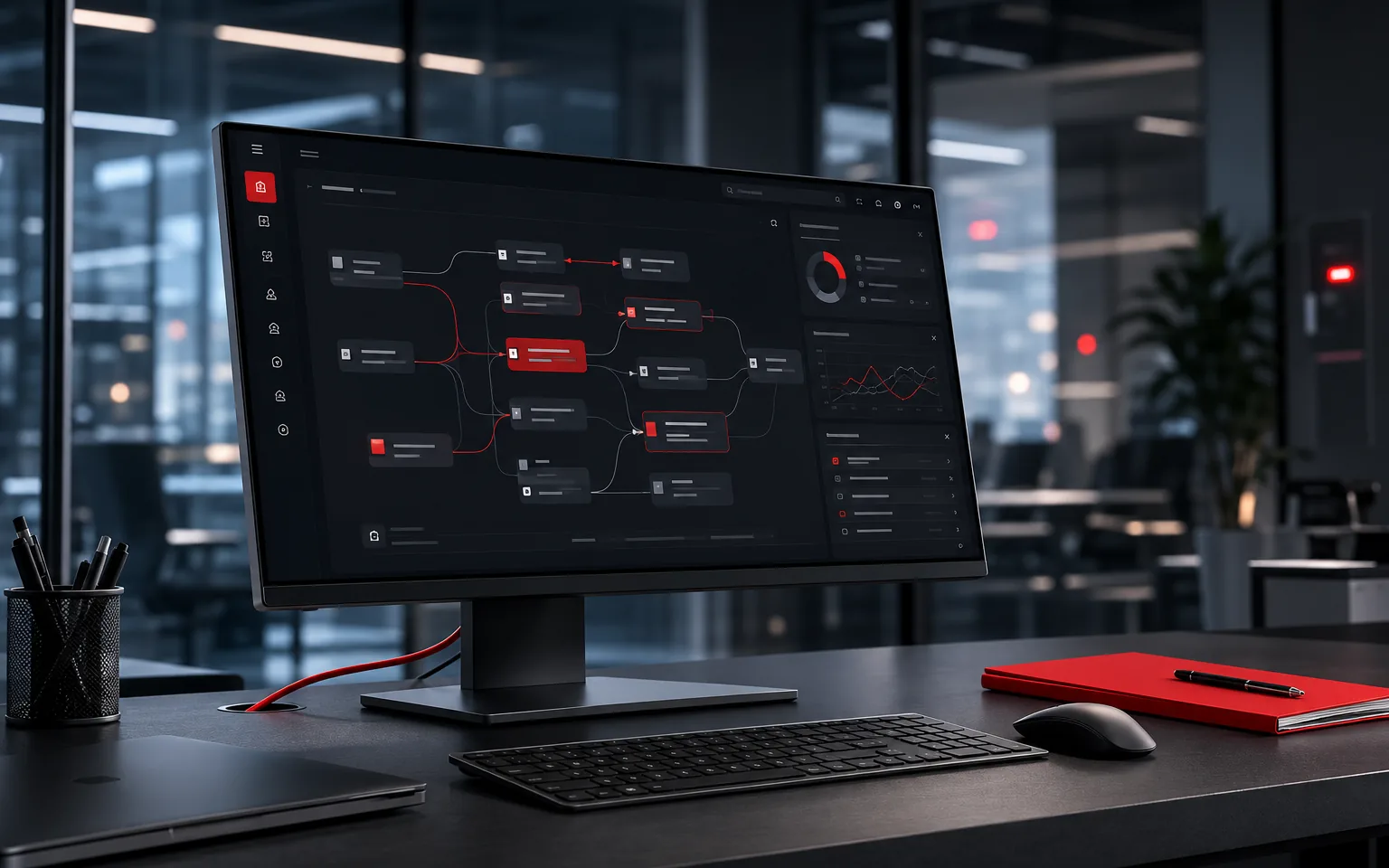
- Low-code approach: integrations can be designed graphically with minimal programming, allowing a broader group of employees to create integrations.
- Automated deployment: based on the integration design, the platform automatically builds the integration microservice and deploys it to the target environment.
- Catalog and versioning: every integration is registered, versioned, and auditable.
- Operation in the internal environment: integration microservices run in the Application Private Cloud (APC), and the entire process from design to operation takes place within the Social Insurance Agency’s environment.
- Standardization across the organization: new integrations follow the same approach, whether they are built by Social Insurance Agency employees or by suppliers.
Delivery
The project was delivered by Aspecta in cooperation with the Social Insurance Agency team as part of the BPM&API project. Delivery took place in several phases and lasted approximately 7 months:
- Analysis and design (June to September 2025): requirements analysis, assessment of APC services, design of the platform architecture, and definition of the process for creating, deploying, and operating integrations.
- Development and implementation (October to December 2025): preparation of the integration microservice template and automated CI/CD pipelines, deployment of the graphical design tool and the integration management console, and connection to APC monitoring, logging, and security services. The delivery also included a sample integration microservice.
- Testing and acceptance (November to December 2025): platform testing and acceptance tests in the Social Insurance Agency’s test environment.
- Training, documentation, and go-live (January 2026): training for integration designers, testers, and administrators, handover of documentation including the designer’s guide, and start of production operation.
Results
| # | Area | Starting point | After delivery |
|---|---|---|---|
| 1 | Integration platform | No central platform | 1 central platform for designing and operating integrations |
| 2 | Integration monitoring | No unified oversight | Every microservice is automatically connected to monitoring and logging |
| 3 | Integration development | Direct connections, file exchange, ad-hoc scripts | Graphical design with minimal programming |
| 4 | Change auditability | No common catalog of integrations | Integration catalog with version history in a Git repository |
| 5 | Deployment | No unified process | Automated build and deployment through CI/CD pipelines |
| 6 | Security | No unified management | Unified access control and secrets management |
The platform provides the Social Insurance Agency with a technology foundation for future integration development between administrative systems, central components, and systems outside the Social Insurance Agency’s infrastructure. Specific integrations of administrative systems are not part of this delivery; they are built on the platform in follow-up projects.
Conclusion
The Social Insurance Agency now has a central integration platform that speeds up and simplifies the development of new integrations, standardizes development and operating procedures, and provides a common foundation for further development of digital services.
The project introduced a cloud-native solution in a regulated public administration environment, built on open-source technologies supported by Red Hat, with an emphasis on standardization, security, and high availability.
“The platform will also enable more effective cooperation between development, operations, and security teams and provide a technology foundation for the organization’s future digital services.” (Detailed Solution Design, BPM&API project)